
Author: Stan Switaj
October 2026 was the worst month PHP has had in a long time. PHP is the language under WordPress, Drupal, Joomla and most of the web: by W3Techs' count it runs about 70% of all websites whose server-side language can be detected. In the space of ten days, PHP itself (not a plugin, not a theme, the language) was found to have two flaws that let a stranger take over a server with a single web request, a third flaw arrived with no patch, and attacks began in the wild.
I build my sites in Python 3, and I publish on EaglePress, a Python 3 CMS (this site, topcodercloud.com, runs on it). So I have an obvious point of view. Below I set out what happened, as observation with sources, and then offer some light commentary on why I think a Python 3 CMS is the better choice for security, for staff time and for the profit line.
What happened: PHP2Shell
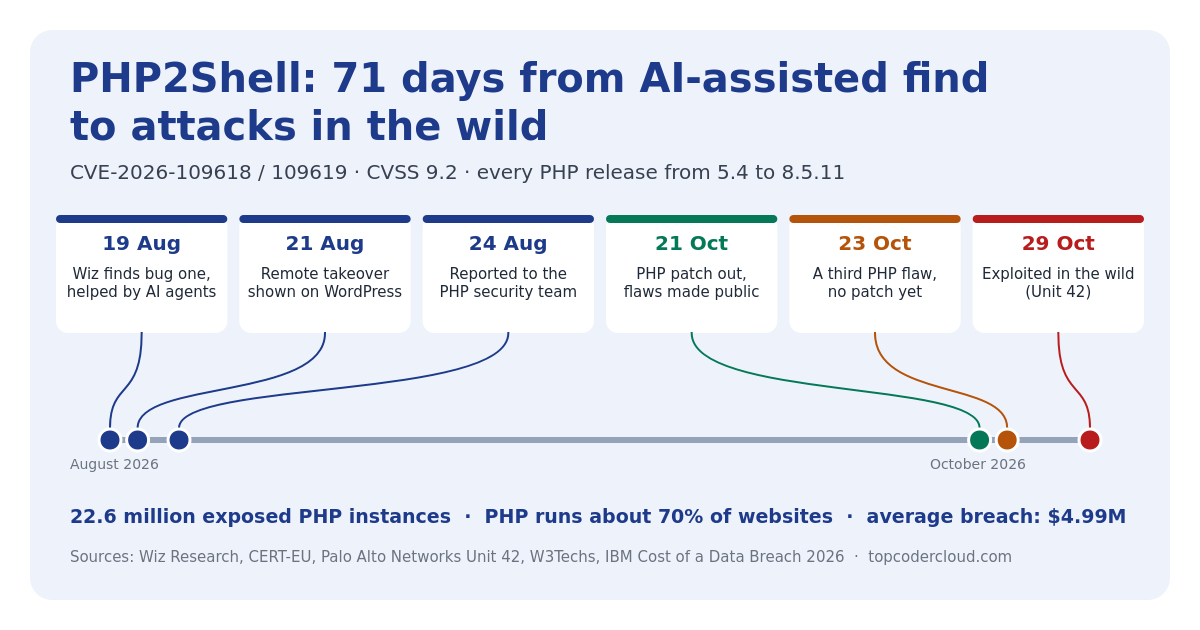
On 21 October 2026 the PHP project released fixes for two critical vulnerabilities, nicknamed PHP2Shell:
| CVE-2026-109618 | CVE-2026-109619 | |
|---|---|---|
| What it is | Remote code execution through memory corruption when PHP runs out of memory part-way through a request | Remote code execution through "stale global state": data from one request survives after its memory is freed, and a later request on the same worker uses it |
| Severity | CVSS 9.2 (critical) | CVSS 9.2 (critical) |
| Affected | Every PHP release from 5.4 through 8.5.11 | Same |
| Fixed in | PHP 8.5.12, 8.4.27, 8.3.36, 8.2.35 | Same |
A few facts stand out from the advisories:
- No login is needed, and the application doesn't matter. CERT-EU reports that the PHP team demonstrated an exploit in which one unauthenticated request triggers the attack before any application code runs. Wiz, who found the bugs, write that "exploitation does not depend on a flaw in the application's code".
- The exposure is enormous. Palo Alto Networks' Unit 42 counted over 22.6 million exposed instances that were potentially vulnerable.
- Old PHP gets no official fix. PHP 8.1 and older are end-of-life. The PHP team published only minimal source backports for 7.4, 8.0 and 8.1.
- Attacks followed quickly. Proof-of-concept code circulated within days, and on 29 October Unit 42 confirmed active exploitation, chained with a Linux kernel flaw to gain root, against internet-facing management interfaces of its own firewalls (about 0.02% of its installed base).
A third flaw, and no patch yet
On 23 October PHP disclosed a third remote code execution flaw, CVE-2026-115560. Upgrading to the PHP2Shell releases does not fix it. As of CERT-EU's advisory there were no details and no patch: PHP judged it a risk only to unusually configured applications and said it would not issue an out-of-band release. Until the next regular release, the advice is to set session.upload_progress.enabled=0 and restart every PHP worker.
It isn't only PHP itself: the plugin problem
Most PHP sites aren't plain PHP. They are WordPress plus a stack of plugins, and that is where most of the trouble has been for years:
| Measure | Figure | Source |
|---|---|---|
| New WordPress-ecosystem vulnerabilities in 2025 | 11,334 (up 42% on 2024) | Patchstack |
| Share found in plugins / themes | 91% / 9% | Patchstack |
| Weighted median time to first exploit, most-targeted flaws | 5 hours | Patchstack |
| Vulnerabilities with no fix at public disclosure | 46% | Patchstack |
| WordPress vulnerabilities published, Q2 2026 alone | 2,073 | Wordfence, via The Hacker News |
| WordPress sites compromised in that quarter | about 573,000 | Wordfence, via The Hacker News |
One October example: the Bricksforge plugin flaw (CVE-2026-85097), rated the maximum CVSS 10.0, let unauthenticated attackers upload and run PHP code. Patchstack saw exploitation attempts begin on 7 October.
AI changed the clock
The PHP2Shell bugs were not new. Wiz describe them as decades old. What was new was how they were found. Wiz say their researchers used AI models and agents (Gemini 4 Argon and GPT-5.6 Sol among them) to find the flaws, chain them together, adapt the exploit to different PHP versions and validate the patch. Their own timeline shows the first bug found on 19 August and remote takeover shown against Drupal on 20 August and WordPress on 21 August.
That cuts both ways. The same tools that help researchers find a bug help attackers weaponize it. Patchstack writes that attackers are "increasingly capable of autonomously finding and exploiting security vulnerabilities". IBM's 2026 breach report found that more than one in four organizations hit by a malicious attack said it involved AI, adding about $1 million to the average cost. The window between "a flaw is announced" and "your server is being probed" is now measured in hours.
What it costs: revenue and time
The averages from IBM's 2026 Cost of a Data Breach report:
| Measure | Figure |
|---|---|
| Average cost of a breach, worldwide | $4.99 million (a record, up 12%) |
| Average cost in the United States | $11.5 million |
| Average time to identify and contain a breach | 247 days |
Those are the costs of a breach. The cost of not being breached is real too: emergency patching on a Tuesday night, testing that the patch didn't break the site, re-checking every plugin, explaining to customers why the store was down for maintenance. Every PHP2Shell-sized event repeats that bill across every PHP server a company runs. In the age of AI, those events come faster.
Why a Python 3 CMS is an improvement
Here is my commentary, offered lightly, with the specifics of EaglePress since that is what I run.
1. A fresh start for every request. PHP2Shell abuses leftover state: memory from one request is still there when the long-running PHP worker serves the next one. EaglePress runs each request as a new Python 3 process that exits when the page is sent, so one visitor's request can't leave half-built state behind for the next. That design removes the whole class of problem PHP2Shell belongs to.
2. Fewer third-party add-ons. With 91% of WordPress vulnerabilities in plugins, the safest plugin is the one you never install. EaglePress builds the everyday features into the core (posts, pages, media, comments, users, themes, Markdown) instead of relying on a marketplace of thousands of add-ons from thousands of authors.
3. Sound security habits in the code. In the EaglePress source:
- passwords are salted and hashed with PBKDF2-HMAC-SHA256 at 310,000 rounds
- database queries go through parameterized SQL, so typed text is never pasted into a query
- session cookies are HttpOnly and SameSite
- user input is HTML-escaped before it is shown
4. Readable code, now that AI reads code too. Python's plain, readable style makes it easier for a person, or an AI assistant working for you, to audit what a site actually does. When the attackers have AI, it helps a lot if the defenders can read their own code quickly.
5. Better for the profit line. Fewer emergency patch cycles, fewer plugin licences and audits, and a smaller attack surface mean fewer staff hours spent on fires, and less risk of a seven- or eight-figure breach. Python 3 is also the language of AI and data work, so the people who maintain your site and the people who build your AI tools can be the same team.
A fair word: no platform is invulnerable
Python has had its own security fixes in 2026, among them CVE-2026-15308 (a CPU-exhaustion problem in the HTML parser) and CVE-2026-15310 (a denial-of-service flaw), and EaglePress, like any software, keeps improving. I haven't seen anything in Python this year on the scale of PHP2Shell: a remote takeover in the language itself, affecting a decade of releases, with no login needed. Whatever you run, keep it patched and keep backups. My point isn't that Python is magic. It's that the odds, the design and the daily workload favour a Python 3 CMS.
Why the alternatives rarely get a hearing
This part is my opinion, from years of watching how these decisions get made.
Control of the web's everyday tools sits with remarkably few hands. A handful of platforms, their plugin marketplaces, the hosting companies whose one-click installers offer one choice, and the agencies whose business is built on that one choice set the default for millions of sites. That concentration works its way down the organization: executives pick "what everyone uses", managers follow, and the IT staff are rewarded for keeping the standard running, not for asking whether it is still the right standard. Raising an alternative can feel like a career risk. So the conversation narrows to which plugin, which patch, which host, and almost never whether there is a better way.
That is a kind of oligarchy over the tools of the web: a few deciding for the many, and the many rarely invited to discuss it. It costs more than money. It keeps good ideas out of the room, and it tilts the field against founders. A founder who must start by renting the standard stack, paying for the standard plugins and fighting the standard fires starts behind those who own the platforms. Open, independent alternatives that anyone can download, read, run and own, like EaglePress, give founders a more equal start: lower costs, full control of their own code and data, and no gatekeeper deciding what they may build. I'd like to see that discussion happen openly, from the boardroom down to the server room, because more choice in the tools makes for a fairer, better web.
If you run PHP today
Whatever you decide long term, do this now:
- Update PHP to 8.5.12, 8.4.27, 8.3.36 or 8.2.35 (or your distribution's patched package). If you are on 8.1 or older, plan the move off it.
- Set
session.upload_progress.enabled=0and restart every PHP worker, for CVE-2026-115560 and as an extra guard for CVE-2026-109619. - Update every plugin and theme, and remove the ones you don't use.
Try EaglePress
EaglePress is a free, open-source Python 3 + PostgreSQL CMS. You can download it at eaglepress.org. If you would like help moving a company website or blog from a PHP CMS to EaglePress, with your posts, pages and addresses carried across, let's talk:
Email: ceo@goodinternetsearch.com
Phone: 215-954-4908
Help moving your website from a PHP CMS to EaglePress (Python 3), to be talked about.
Sources
- CERT-EU Security Advisory 2026-018: Critical Vulnerabilities in PHP
- Wiz Research: PHP2Shell, AI uncovers critical RCE vulnerabilities
- Palo Alto Networks Unit 42: Threat Brief on CVE-2026-109618 and CVE-2026-109619 (updated 29 October)
- Datadog Security Labs: PHP2Shell detection, analysis and remediation
- Plesk: CVE-2026-109618 and CVE-2026-109619 in PHP shipped with Plesk
- Patchstack: State of WordPress Security in 2026
- The Hacker News: Attackers exploit CVSS 10.0 Bricksforge WordPress flaw
- eSecurity Planet: IBM 2026 Cost of a Data Breach Report, key findings
- W3Techs: Usage statistics of PHP for websites
- Fortune: AI helped discover the PHP vulnerability (21 October 2026)
0 Comments
No comments yet. Be the first!
Leave a Comment